
When I received the commission from Suntup Editions to make original prints to accompany Arthur Machen’s novella The Great God Pan and the short story “The White People,” I read them and was overcome by the rush of visual imagery they contained.
There is a strong spirit of the rural world as a deeper world—an ancient place which contains things humans cannot comprehend without madness. The city and comfortable society in these stories fades into a dream, laid thinly over a rocky landscape.
The intense dreamworlds in Machen’s stories I thought must have been inspired by his upbringing in south Wales. The wetness of Wales, where I live, allows a microlandscape of mosses and lichens to flourish, giving the sense of worlds beyond worlds as you look closer into the details. This felt perfect for Machen’s vertiginous unfolding of unknown layers of reality.
For The Great God Pan, the first drawing I made was of the Japanese bureau, which for me acted as a sort of guilty scrying device for the quasi-scientific gentlemen who are drawn to strange testimonies and esoteric mysteries. I decorated the study with carpet and wallpaper made up of forms from diagrams of cell division to show the hum of life’s rude forces under the noses of these civilised gentlemen. Prancing forward with horrible gallops is the irresistible bureau, demanding to be acknowledged as the rude basis of life with its hairy goat-legs.
For “The White People,” I wanted to bring out the sense of an animistic landscape—an embodied world where everything has nerves and blood and consciousness. Machen’s image of a stone sprouting flowers is the symbol that introduces this concept for me. I drew it floating under the moon and stars and springing awkwardly to life with clumsy stony flowers.
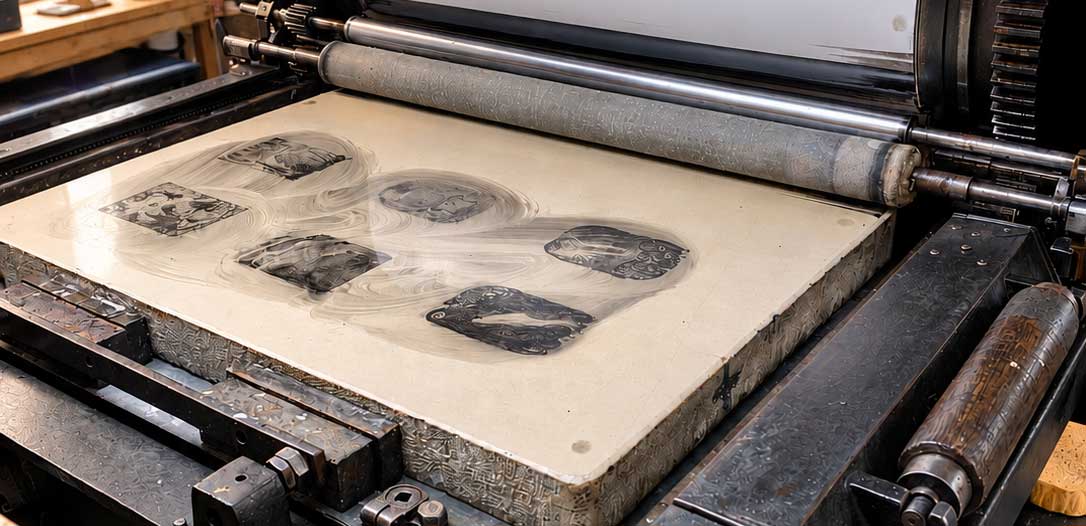
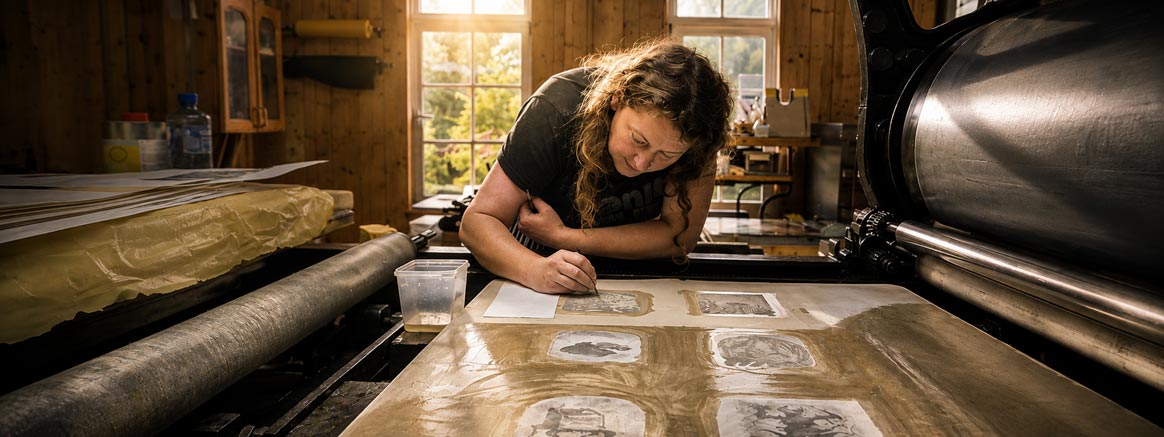
Making stone lithographs is a magical process; really, it is as if a stone is sprouting flowers. The action takes place solely on the flat surface of the limestone slab. There is no carving or etching into the surface—the drawing is made with greasy crayons and inks, and then treated with acidified gum arabic so that when the drawing is eventually washed off the stone, and rolled with printing ink, the drawing will—seemingly magically—reappear. The stone attracts the greasy printing ink to the drawn marks, and if kept damp, will also repel ink from the undrawn areas. In this way, many prints can be taken from the stone, providing the inking and damping is consistent.
To make drawings on the stone, I like to work in an intuitive way, spilling lithographic tusche (a suspension of greasy pigment in distilled water) into thin webs that suggest forms and meaning, then scrying into them with further pen and ink drawing. I felt that the web or rootlike networks of the tusche were the ideal medium for bringing to life Machen’s vision of an imaginatively and biologically active world.
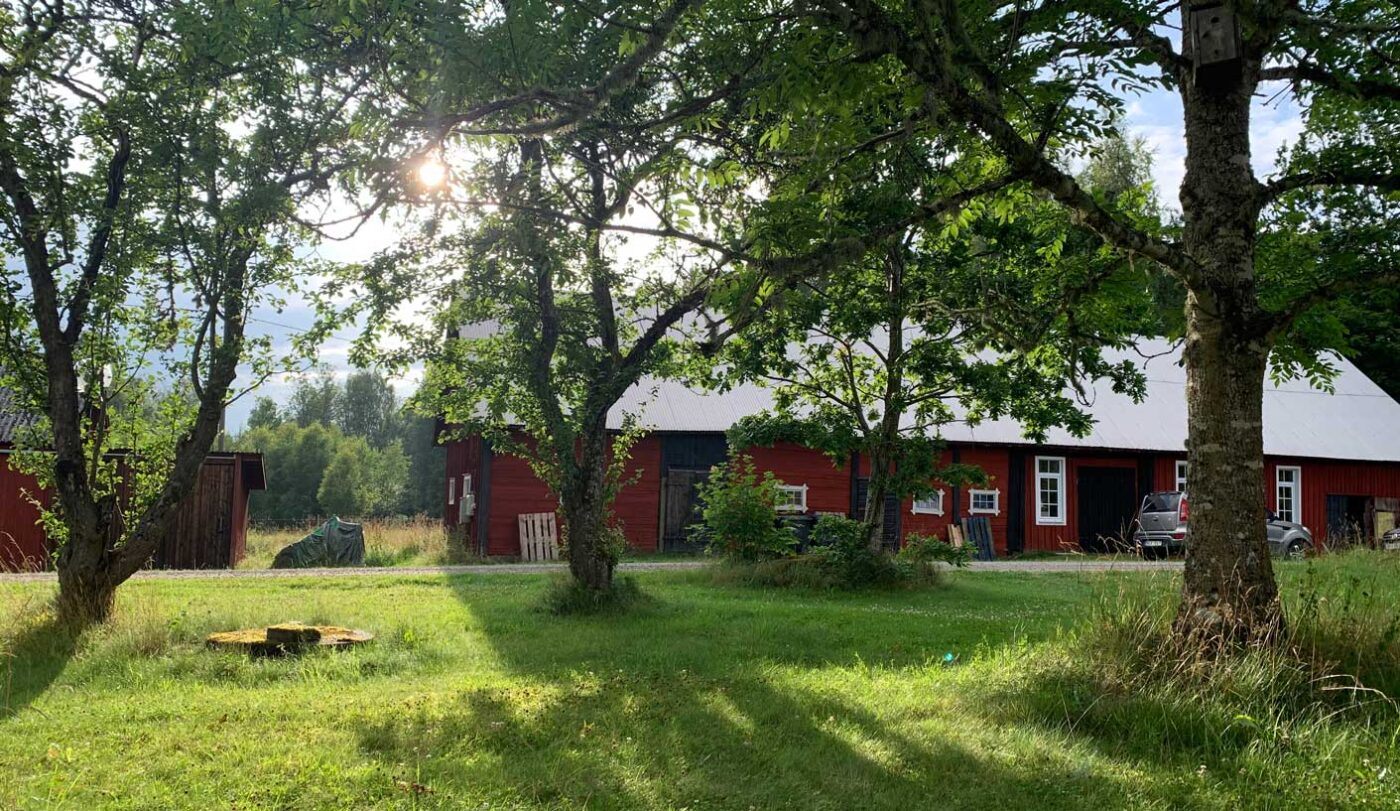
Allowing for a respectable margin of error, we needed a considerable number of each lithograph printed, and it became too many for one person to print. I contacted Patrick Wagner and asked if he could take on the project with me at his collaborative printshop, Black Heart Press, in Småland, Sweden. We laid out a plan of action; I would come and stay for one week, with four days for me to draw 8-12 images onto two large lithographic stones, followed by three days as part of the three-person printing team running the press. The press is an antique, a beautiful mechanical Schnellpresse built in 1904, its huge flywheel powering the oiled pistons and cogs in hypnotic motion.
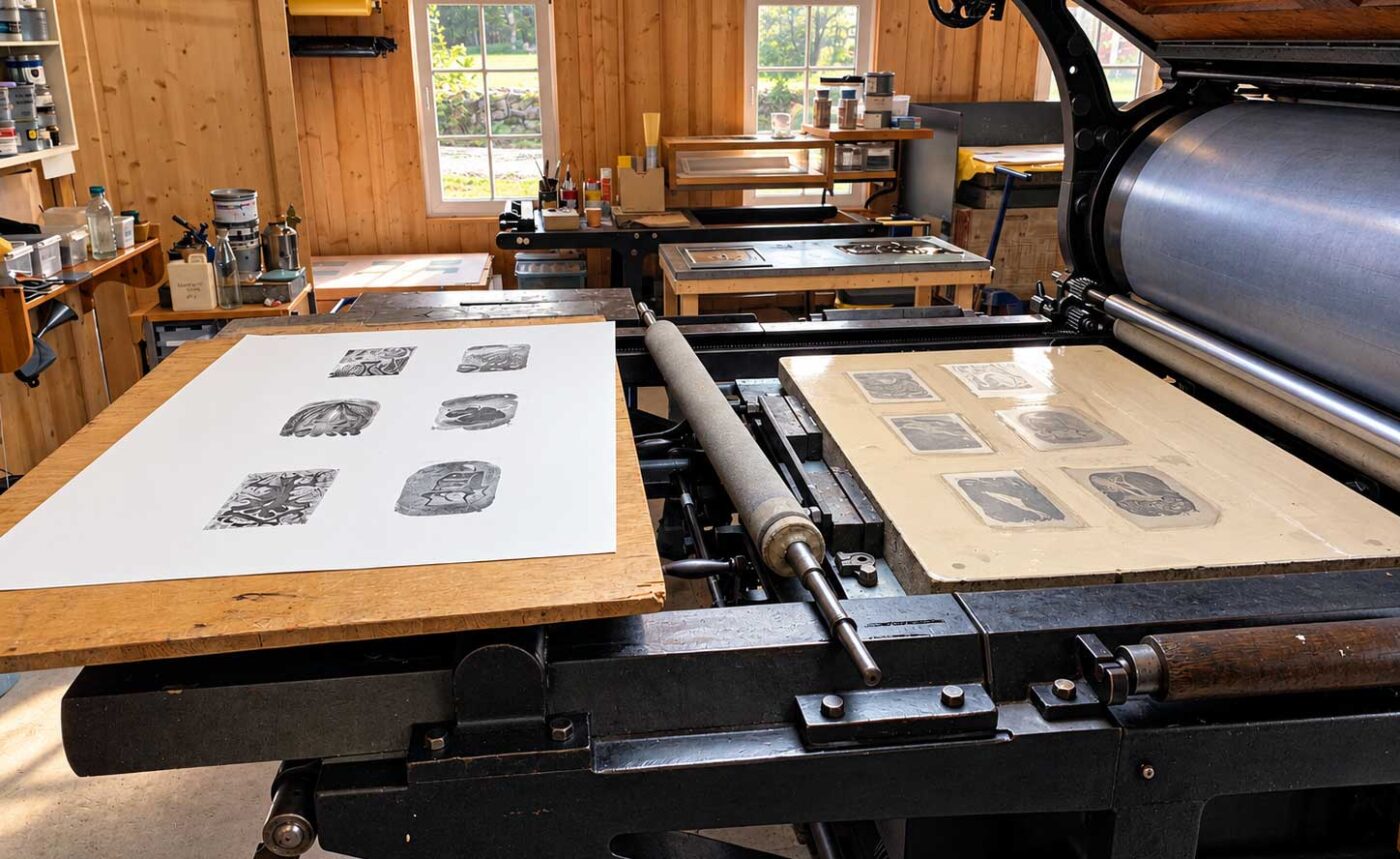
As an artist working in etching or lithography, I am quite used to rethinking the image to respond to chaotic results during the unpredictable material processing of plate or stone. Unexpected things are almost bound to happen—and in this case, the drawing time was tight, the images very small and the detail level of my planned sketches was high. We had little room for manoeuvre.
I arrived at nightfall, smelling the scent of oaks and pines in the rain, to enjoy the kind hospitality of Patrick, Anna and baby Indigo. In the morning, after a hasty coffee swigged from a Moomin-mug, Patrick introduced me to the enormous and beautiful litho stones I was to draw on, which he had carefully drawn up with the correct margins. It was time to sink into the making, and forget everything apart from the imaginary worlds I had been dreaming into all summer. I worked through my images, occasionally sitting in the sunshine under an old pear tree luxuriantly fronded with lichen, and communing with the occasional visiting butterfly.
Once I had completed the first stone, I watched as Patrick swept a frothy wave of gum arabic and nitric acid fizzing across the six hard-won drawings. He had to etch them strongly enough so that they would not fill in with excess ink during the edition run, but not so strongly that delicate tones were burned out. When the time came to wash out the images with turpentine and roll the stone up with ink for the first time with the leather roller, the suspense held us silent—but the drawings reappeared accurately.
We began printing the stone on the press. We were using unusually thin paper to match the weight of the letterpress sheets for the book—and this meant we ran into problems getting enough pressure and ink absorption to make good strong prints. Beyond a certain point, we could not increase the pressure of the large roller lest it start to bounce across the stone. We realised we would need a colour wash over the drawings to increase contrast and detail, once the prints were made. Once that was done, it became apparent that the dark areas of drawing were still too light—a third printing was needed. One week was not enough—a second visit to Sweden was necessary to print the second stoneful of drawings.
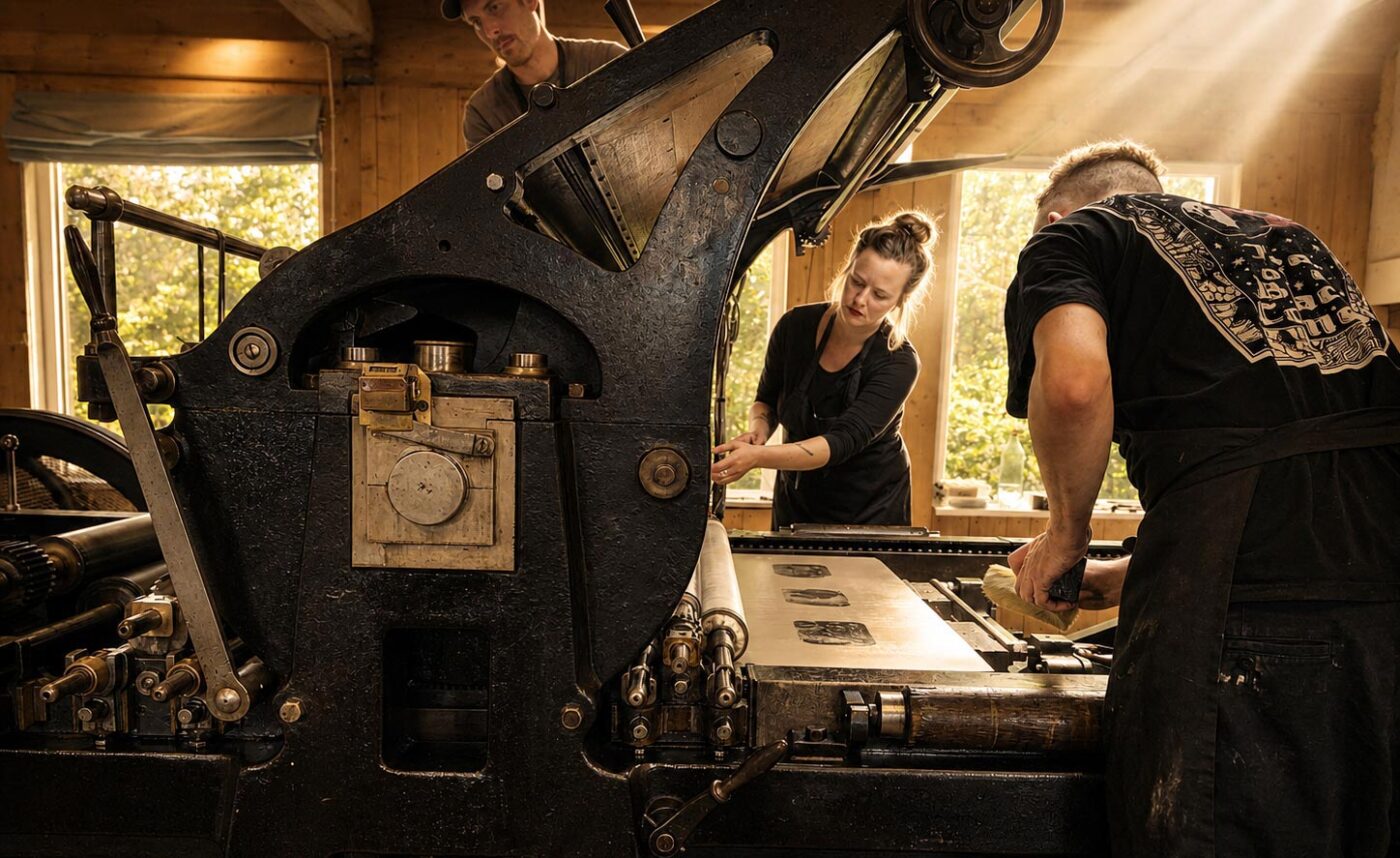
When I returned, it was September, mushroom season. It felt so appropriate to Machen’s vision to be eating these delicious goblin fruits from the underworld—feeding from the hidden mushroom mycelia, thinking of them looped and fronded amongst the roots of the oaks, birches, pines and bilberry bushes, all these teeming organisms nourishing each other under the earth. There was an obsessive hunting, gathering and drying of mushrooms, and with Anna’s mother Ula’s help, I was delighted to return home with a big tub of dried ceps. Once the final printing was done, there was just time for a sunset sauna by the lake, easing out the kinked drawing muscles and bruises from leaning against the unyielding press to take the prints from the roller as they emerged one by one. The lake water was beautifully clear and warm, with the spicy scent of bog myrtle as you climbed out to get back in the steam.
It was an intense and wonderful time, and I am very grateful to Patrick and the amazing printing team of Magnus, Anna and Oskar for their dedication to the project. All that collaborative hard work by our creative and nourishing printmaking mycelium ensured that we ended up with a collection of images to enter the secret and enchanted otherworld of the fine-press book. My thanks to Paul at Suntup Editions for giving me the opportunity for this transformative drawing and printing experience.
Flora McLachlan